
5 min read
Key Signatures & Major Scales
This Guide gives a basic explanation of major scales and key signatures, using the circle of fifths. It's helpful background for harmonium players and vocalists who want to understand what key a chant is in and how to move it to a different key.
Major Scales
A major scale is seven notes that follow the same pattern of whole steps (W) and half steps (H), then return to the starting note an octave higher:
W – W – H – W – W – W – H
A half step is the distance from one key on the harmonium to the very next key, black or white. A whole step is two half steps.
Starting on C, the pattern uses only white keys: C D E F G A B C. Starting on any other note, the same pattern needs one or more black keys (sharps ♯ or flats ♭) to keep the steps in the right places. For example, G major is G A B C D E F♯ G.
Key Signatures
A key signature is the group of sharps or flats written at the start of each line of music. It tells you which notes are sharp or flat throughout the piece, so they don't have to be marked every time. Each major key has its own key signature.
Sharps and flats always appear in the same order:
Sharps: F♯ C♯ G♯ D♯ A♯ E♯ B♯
Flats: B♭ E♭ A♭ D♭ G♭ C♭ F♭
Quick ways to name the key
Sharp keys: go up a half step from the last sharp. With F♯ and C♯, the key is D major.
Flat keys: the second-to-last flat is the key. With B♭, E♭ and A♭, the key is E♭ major. (One flat, B♭, is F major.)
No sharps or flats: C major.
The Circle of Fifths
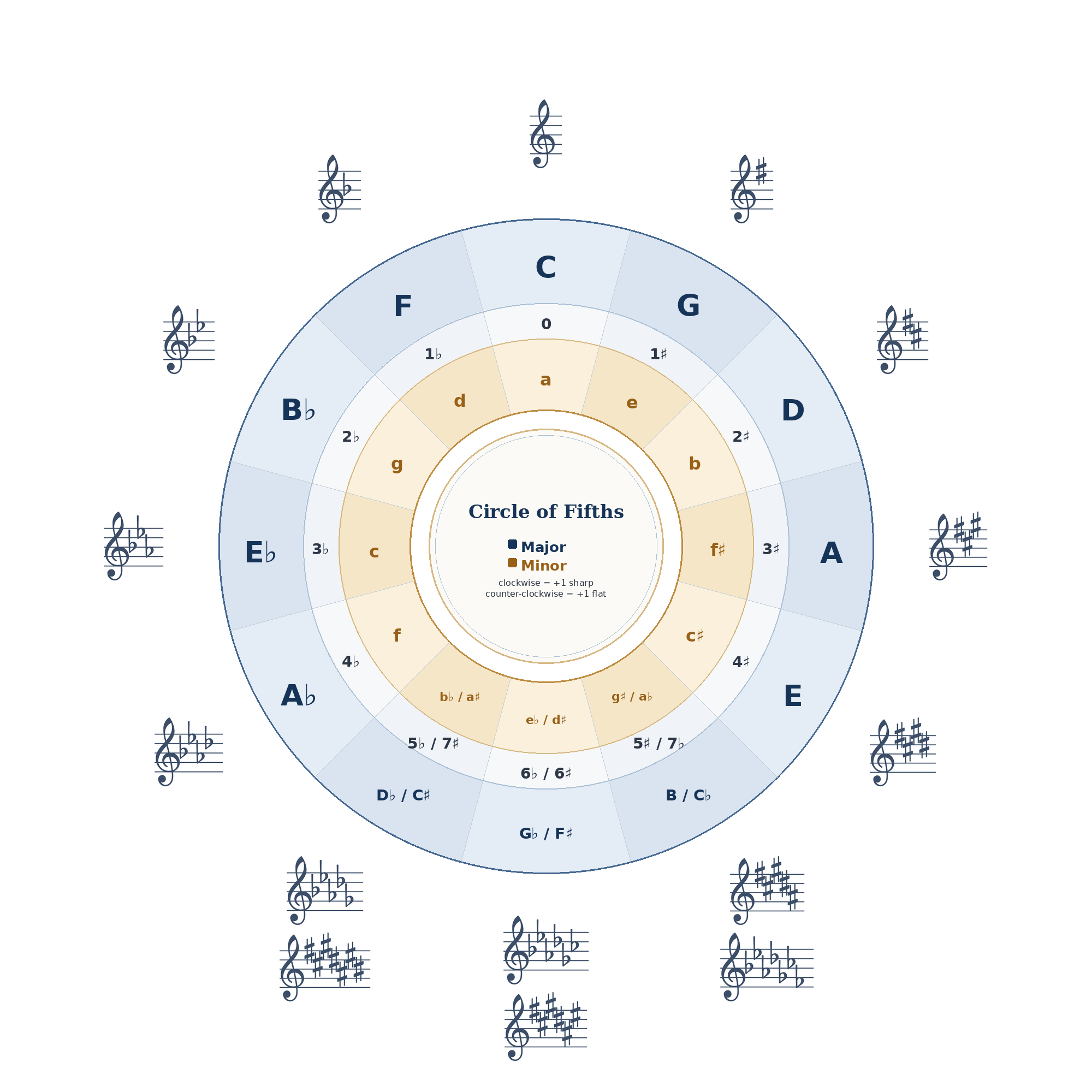
The circle of fifths arranges all the major keys around a circle, with C major (no sharps or flats) at the top.
Going clockwise, each key is a fifth higher than the one before (C, G, D, A, E, B…) and adds one sharp.
Going counterclockwise, each key is a fifth lower (C, F, B♭, E♭, A♭…) and adds one flat.
At the bottom, some keys can be written two ways that sound the same on the harmonium, such as G♭ major (6 flats) and F♯ major (6 sharps).
Keys that sit next to each other on the circle share all but one note, so moving a chant to a neighboring key is a small change.
Relative Minor Keys
The inner ring of the circle shows each major key's relative minor, which shares the same key signature. For example, A minor has no sharps or flats, just like C major, and E minor has one sharp, just like G major.
To find the relative minor, count down three half steps from the major key's starting note (C down to A, G down to E).